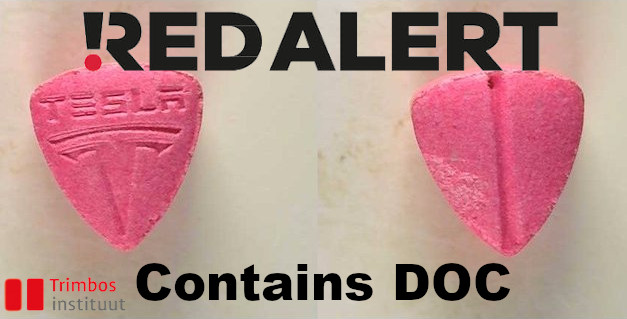
The Trimbos Institute in The Netherlands have issued a Red Alert about a batch of pink tesla pills. The pills were sold as containing a psychedelic drug called 2C-B. Instead, these pills contain DOC.
DOC has a duration of 24 hours and the pills contain a very high dose of this drug. The effects take 2-3 hours to kick in, so if a person took more because they “were not working” then the effects would be very dangerous.
DOC causes long (24h) trips.
One pill from this batch is a large dose, so the trip would be intense and overwhelming.
It can take 2-3 hours to notice the effects
Some people have already been hospitalised by these tablets
If you take these tablets and experience intense negative effects then you can call for medical attention.
We consider this to be good advice because of the strength of the dose in the tablets. Trimbos issue 1-2 red alerts per year. This is an extremely serious alert and should be spread very widely because the risk is very high.
Tesla tablets are a popular design that have been in circulation since around 2014. They normally contain the drug MDMA (sometimes called “ecstasy” when in tablet form). Since it is easy to make a tablet it is possible for a producer to put any drug in these, and we have seen this in the past.
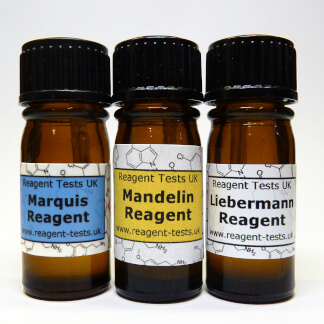
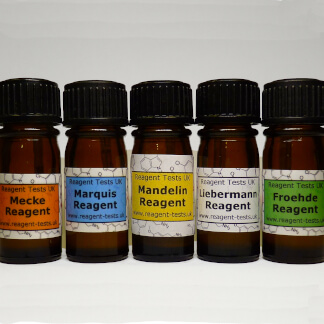
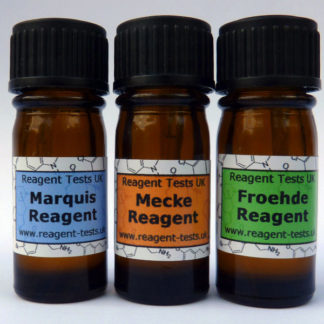
DOC in tablets is easy to detect using the mecke reagent. MDMA turns blue/black. 2C-B turns yellow. DOC turns green/brown.
The easiest way to prevent risk from drugs is not to take them, but if you do take them then testing is the fast way to avoid situations like this.
Some people do take DOC on purpose – it is a strong psychedelic drug. The dose needs to be controlled carefully and there needs to be enough time for the experience (24 hours). https://psychonautwiki.org/wiki/DOC
LSD is a highly potent psychedelic drug, with a teaspoon of crystals (3g) providing enough for 30,000 doses. It’s normal for the potency of different drugs to be different and there are many pharmaceuticals with this kind of potency. What’s difficult is that home equipment cannot easily measure out the 100 micrograms required for a dose.
To address this, LSD is distributed in pre-measured form. Dissolved in liquid (1 dose per drop) or soaked into blotter paper (1 dose per 5mm square). Less common is to stir the LSD into gelatin, then pour it out to set. The gelatin can be broken off in squares which represent one dose.
The problem is, gelatine can react directly with reagent test to give confusing results. This means we have to separate the LSD from the gelatine. Luckily, this process is very easy, simply requiring chlorine-free water to extract the LSD.
Boiling water sterilises it and removes any chlorine that could damage the LSD, and gelatine doesn’t dissolve well into it.
Equipment
You will need:
Recently boiled water that has cooled below 80*C
Something to manipulate the water like a syringe, pipette or even a teaspoon
A geltab
A small container to dissolve the geltab in, such as a shot glass
Absorbent paper, cut into a 1cm x 1cm square
Procedure
Boil the water and start cooling
Dip the container into the water to pre-heat it, then take it out
Put the geltab into the container
Add half a teaspoon of the water (1 mL).
The mixture must be at least 40*C for at least 5 minutes.
Cover the container
Allow to soak for 24 hours
Place the paper square on the side of the container, half in the water and half out.
Leave the container un-covered to evaporate. The water will migrate into the paper, carrying the active chemicals with it.
You can now treat the paper like a normal piece of blotter, so cut off a quarter and place the test granules on top.
Reagent Tests UK has always been committed to making products that people love to use. From the very start, the goal was to run the type of company that people love to do business with, due to the buying experience but also the quality of the products.
While colorimetric laboratory tests have existed for over 100 years, the practise of reagent testing drugs is relatively new and until 2010 there were very few suppliers. Accordingly, there is a relatively small population of knowledgeable people who know about the tests and there are still many improvements to be made in terms of the consumer products.
Given that reagent tests need to undergo a chemical reaction in 1-3 minutes, it’s not surprising that they are highly reactive chemicals. While this makes them very convenient and fast to use, it also means they can react with things that we would prefer them not to. We have used glass bottles for our products since the beginning because even unreactive polyethylene plastic accelerates the degradation of reagents, through slight permeability as well as direct reaction with the reagents themselves.
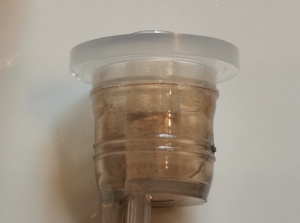
The plastic at the bottom of this dropper has permanently discoloured due to reaction with the reagent.
However, glass is a hard material to shape and as a result we have always used plastic dropper tips, meaning that a small amount of plastic does still come into contact with the product. This is minimised by storing upright, but still has an effect.
As we’ve grown we’ve looked for ways to improve our products and in late 2018 we had the idea to try making the plastic droppers more chemical resistant using fluorine treatment. We were delighted to find that the treatment increased the shelf life of reagents by 20-40% without any other impact on performance, and started selling reagents in fluorinated bottles in 2019.
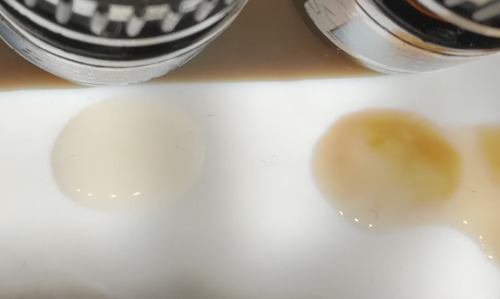
The marquis reagent stored for 5 months at room temperature. The bottle on the left was fluorine treated and has discoloured much less.
Why make this public?
Of course, it’s difficult to claim that your products have a markedly longer shelf life without telling anyone why. We are really proud of our products and naturally we want to be able to show off their quality, so the time has come to reveal another reason why our customers can be happy they chose to buy from us.
Even when we’re not shouting about it, our products are being developed and improved, and this is one of the things that makes it so easy to be proud of our products and easy for our customers to know that they are getting the best value.
As of August, we’re pushing ahead with our next innovation and we know that we only serve some of the thousands who use colorimetric tests worldwide. We believe that a rising tide lifts all boats, and if every testing product is better then testing will slowly start to spread beyond the knowledgeable core of users that currently exist. This in turn will help Reagent Tests UK even if not everyone buys from us and importantly it helps all the people who rely on the results of the fantastic technology that is reagent testing.
Maybe this doesn’t revolutionise the whole scene but short shelf lives are definitely disappointing to customers so we urge our kindred spirits running other companies to investigate fluorinating their bottles, particularly where they are using plastic bottles and droppers.
Technical Notes
We opted for the maximum level of fluorination available. The lowest level did not produce good improvements in shelf life.
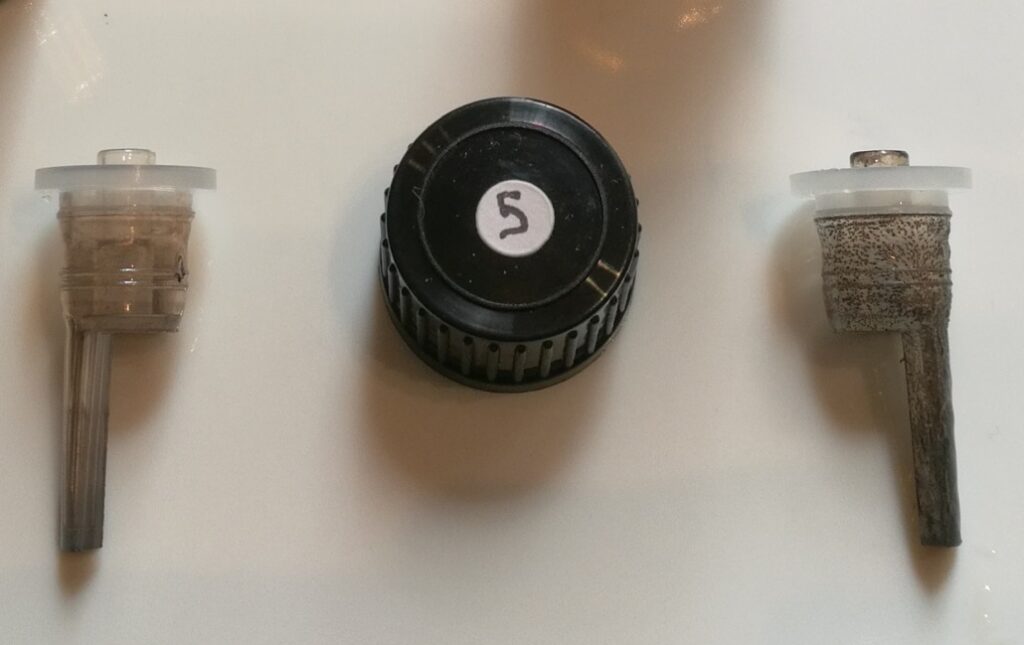
Interestingly, the actual plastic itself had an uneven pattern with the mecke reagent (which shows the worst discolouration of all reagents) and although the shelf life was massively improved, the plastic itself seemed almost worse.
The fluorinated dropper is shown on the right in this photo. The plastic displays an uneven pattern after exposure to the mecke reagent.
Find out about the fatal effects of PMMA at the end of the article.
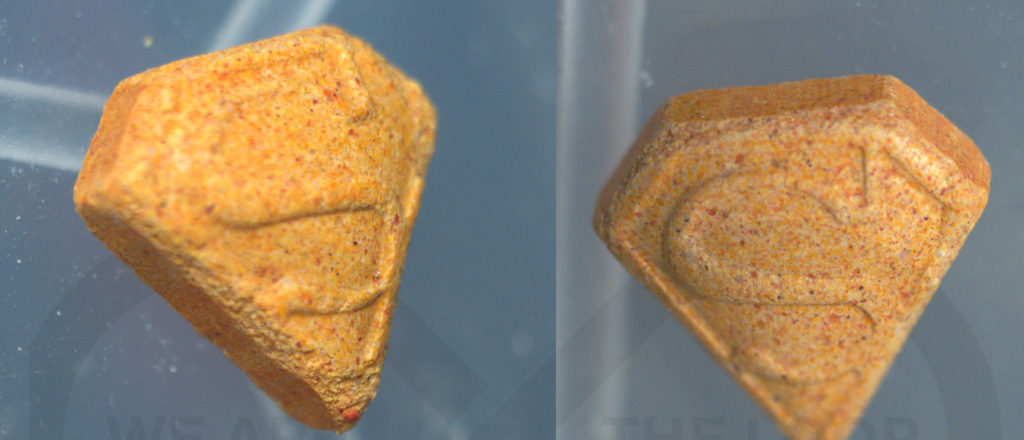
The Superman logo tablet has a long history of use for ecstasy which is surprising considering that there have been a number of batches containing extremely dangerous adulterants. You would think that its reputation would stop anybody wanting to buy it ever again but it’s 2019 and there is another deadly Superman ecstasy pill on the market.
The 2019 pills are orange and have a slightly thinner “S”. This is not surprising because the way that pills look does not tell us anything inside them. This orange superman tablet was detected multiple times at the Boomtown 2019 music festival. It is very likely to be sold on the wider market. The only way to know the contents of a pill is to test them.
Photo Credit: The Loop / Sam De Neijs
How to test ecstasy tablets
Testing any recreational drug to get an idea of the contents is easy and can be done at home. All you need is a tiny scraping of a tablet or a crystal the size of a grain of sand.
Adding one drop of a reagent test liquid to this will give a colour change, and that colour change tells us what might be (or importantly, might not be) present.
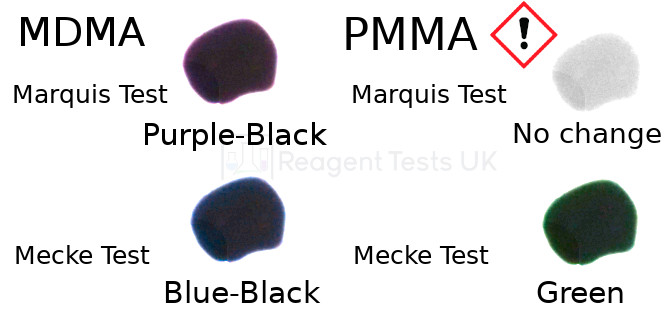
PMMA reacts very differently to MDMA, so these pills would be very easy to tell apart from a pill with MDMA in it.
Type of home MDMA test
Test result for PMA and PMMA
Marquis Reagent
No colour change
Froehde Reagent
Pale blue
Mandelin Reagent
Brown
Liebermann Reagent
Purple-brown
Mecke Reagent
Green
It is necessary to use more than one test on each sample to reduce the chance of confusion. For example, if you only used the liebermann reagent then paracetamol and PMMA have the same purple-brown colour change. If you use the mecke reagent as well then the difference is immediately obvious because mecke would not change colour for paracetamol.
High doses totally disable serotonin regulation causing the brain and body to fatally overheat
The effects take a long time to fully kick in, so people take extra before the first dose has taken effect
The desirable effects are similar to weak MDMA, a feeling of warmth and energy
The overheating effects become dangerous before the desirable effects become like a full dose of MDMA
You will notice that all of these factors are things that make people think they have a real MDMA-containing ecstasy pill based on the effects, so they take more, but become fatal after a short time.
The last time we wrote about superman pills was in 2016, when they also contained PMMA. Prior to that, a batch of superman pills containing PMMA killed four people in the UK in 2014 after the government refused to issue a warning, despite knowing the dangers of PMMA from batches in previous years.
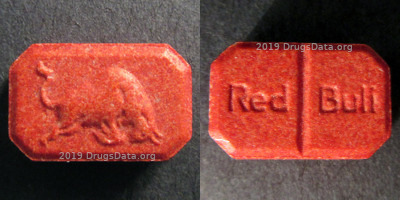
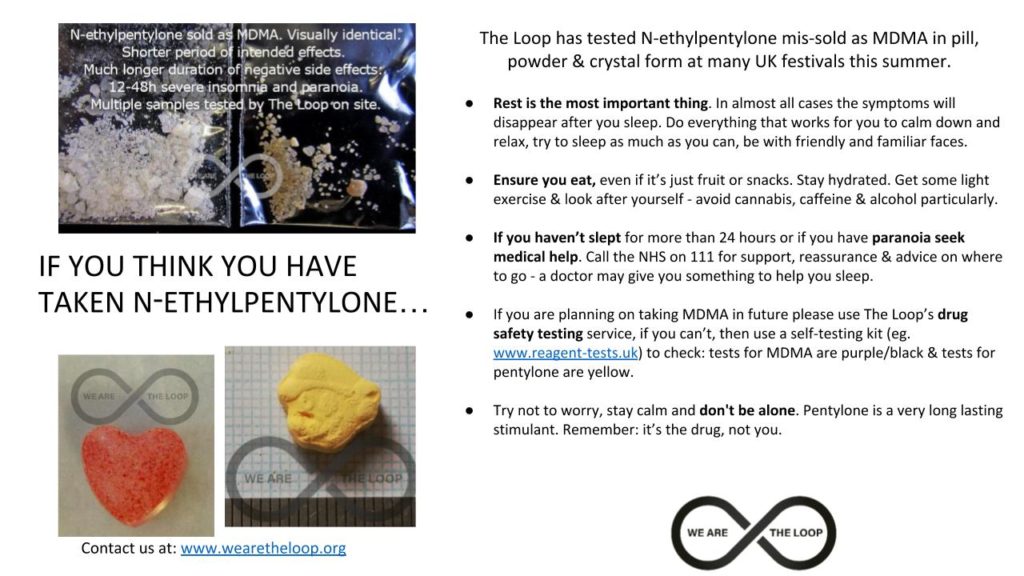
The DrugsData lab run by Erowid has tested this Red Bull tablet from Texas which has the bull logo on one side and “Red Buli” written on the back. There is a breakline and the pill is coloured red. The lab reports the pill does NOT contain MDMA but instead an unknown amount of a drug called “N-ethyl-pentylone“.
Notice the “Bull” actually says “Buli” with the letter i instead of letter l
The tablet appears to be very well-made. This pill has fine details visible, a slight sheen on the surface and no crumbling. This is quite unusual for a pill with no MDMA, which tend to be much lower quality.
Testing Pills
This sample was tested by DrugsData.org who will run a full lab test on ecstasy tablets for $40 US Dollars per whole tablet (100 USD for partial tablets). You can also test pills and other drugs at home using reagent tests. These use a small piece of the pill to give a fast result to alert you if there is no MDMA in a pill. Reagent tests cost around £20 for a pack which lasts for 30 samples.
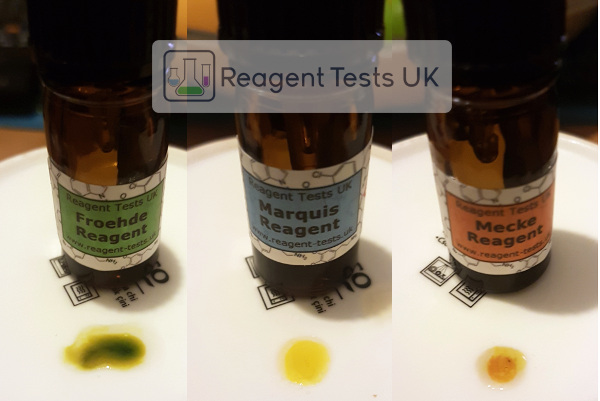
The picture below shows a test result for N-ethylpentylone. MDMA gives a result of purple/purple/blue, you can see this is VERY different to the sample results from the photo.
N-ethylpentylone has VERY different test results to MDMA
Effects of N-ethylpentylone
N-Ethylpentylone is a fairly unpleasant drug because it initially has similar effects to MDMA – stimulation, energy and sociability. Some people do get extremely anxious depending on the dosage, but most have fairly normal effects. These enjoyable effects only last about 2 hours though, so people think they are coming down a bit early.
The big problems start when they don’t want the party to stop so they take some more. Drugs in this class are known to be very more-ish, making people want to keep chasing a high even if they know that the effects aren’t what they should be.
As a rule of thumb, each time someone takes another dose of N-ethylpentylone they will be unable to sleep for an additional 6 hours. If they are partying for 8 hours and they have to take more every 2 hours that’s an extra 24 hours after the party that they cannot sleep.
With a stimulant on board messing with dopamine and no sleep for 2 nights in a row the brain starts to literally go crazy and most people experience horrible anxiety with physical symptoms. More vulnerable people experience panic attacks, paranoia and in cases where people cannot sleep for more than 2 nights, temporary psychosis can emerge.
What to do if you can’t sleep after taking ecstasy
It’s a truly horrible experience for those who go through it but the good news is that as soon as someone sleeps the effects start to reduce massively. Doctors should prescribe a benzodiazepine (like valium), not an antipsychotic. This is because antipsychotics can have severe interactions leading to fatal heart problems when combined with N-ethylpentylone.[1][2]
Remember, it’s the drug, not you. As soon as you have slept you will start to feel normal. We wrote the advice sheet above in partnership with The Loop in 2018.
DXM is a dissociative drug (in the same family as ketamine) which also has activity in the serotonin system. It is most popular in the US as it is readily found in some cough medicines but is also found as a white powder in other places.
Cough syrup cannot be tested with reagents because it contains a number of other chemicals such as water, sugars and colourings. Fortunately it is a legal product and also tends to have an ingredients list to warn about dangerous additives like chlorpheniramine and paracetamol (AKA acetaminophen in the US).
DXM reacts with reagent tests as follows. Slow reactions can be a bit confusing so we would recommend a minimum of two reagents but ideally three or more. As an aside, reagent tests do not give “purity” readings but they do detect substitution and often adulteration, too.
Reagent
Test Result
Marquis
Gray > Black (slow)
Liebermann
Purple > Black
Froehde
Bright Yellow
Mandelin
Green > Pale Blue (Fast)
Mecke
Yellow
The plus side of a slow reaction is that if a fast reaction to a different colour happens while you are waiting, you know that there is something else present.
The MDMA & Psychedelics Multipack is the best option for testing DMT. It contains the ehrlich reagent which is a “binary test” for the presence of compounds in the DMT family (technical term: indole-containing substances). If it stays clear then there is no DMT present in the sample.
If the ehrlich reagent goes purple then you can corroborate with other tests as follows:
Reagent Test
Reaction with pure DMT
Ehrlich
Purple
Marquis
Orange > Brown
Mecke
Yellow > V. Dark Green
Froehde
No change
If the froehde reagent changes colour then you know that other compounds are present.
One of the challenges with drugs from plant origins is that plants contain many compounds and these are extracted by the same process. This makes it very hard to tell if any “other chemical” is from the plant or if it has been added by the person making or selling the compound. We recommend that the Best Practice is to discard any drug which has any reaction not compatible with the pure form of the expected substance.
The hofmann reagent can also be used for testing DMT and should only go yellow for pure DMT. Because the hofmann reagent is very sensitive to similar compounds from plants, it can be impractical for testing plant-derived DMT where there are usually strong green (from 5-MeO-DMT) and orange (from gramine) tones also present.